Updated: October 10, 2026
You have probably seen it in a job description: “CISSP preferred.” Sometimes it sits beside a long list of technical skills. Other times, it is one of the first requirements for a security manager or architect position.
That raises a reasonable question. What does CISSP actually tell an employer—and is earning it worth the time and money?
The short answer is that CISSP can be a useful credential for experienced professionals who want to demonstrate a broad understanding of information security. The longer answer depends on your background, the jobs you want, and whether you are ready to move beyond the part of security you already know well.
This guide explains the qualifications, the eight exam domains, the certification process, realistic costs, and what salary figures can—and cannot—tell you. It also includes a practical study plan, because deciding to pursue CISSP is only the beginning.
A quick distinction: Passing the CISSP exam and becoming CISSP-certified are not the same thing. Certification also requires qualifying experience, a successful application and endorsement, agreement to ISC2's Code of Ethics, and payment of the applicable maintenance fee.
In this guide
- What is CISSP certification?
- Who should consider CISSP?
- CISSP qualifications and experience requirements
- What the eight CISSP domains cover
- How the CISSP exam works
- How to become CISSP-certified
- How much does CISSP certification cost?
- CISSP salary: what can you realistically expect?
- The career benefits of CISSP
- When CISSP may not be the right next step
- How to prepare without wasting your study time
- Keeping your certification active
- Frequently asked questions
- Is CISSP worth it for you?
What is CISSP certification?
CISSP stands for Certified Information Systems Security Professional. It is administered by ISC2 and covers the knowledge needed to design, implement, assess, and manage an organization's security program.
Unlike a certification focused on a single product or platform, CISSP is vendor-neutral. You are not being tested on where a particular firewall vendor puts a setting. You are expected to understand why a control is needed, how it works, what its limitations are, and how it supports the organization.
That breadth is the point. A security decision rarely stays inside one technical discipline.
Consider a company moving customer records to a cloud service. Encryption matters, but it is only one part of the decision. Someone also needs to ask who owns the data, which privacy obligations apply, how access will be approved, what the supplier is responsible for, how incidents will be handled, and whether the company can recover its information if the relationship ends.
CISSP brings those questions into the same conversation.
Is CISSP technical or managerial?
It is both. You need technical foundations, but you also need to understand governance, risk, policy, accountability, and business priorities.
The popular advice to “think like a manager” is helpful only up to a point. It does not mean you should choose a policy answer every time or ignore technical details. It means you should answer from the role and context described in the question, rather than automatically reaching for the tool you would use in your current job.
If a question asks what a security leader should do before selecting a control, requirements and risk assessment may matter most. If it asks which mechanism provides a specific security property, technical knowledge is still essential.
Who should consider CISSP?
CISSP tends to make the most sense when you already have meaningful IT or security experience and want a wider professional perspective.
It can be relevant to:
- Security engineers and analysts who want to move into senior, architectural, or cross-functional roles.
- Network and systems administrators whose responsibilities include access control, secure configuration, resilience, or incident handling.
- Security architects who need to connect design choices with risk and business requirements.
- Governance, risk, and compliance professionals who want stronger technical context for their assessments.
- Security managers and consultants who work across multiple parts of a security program.
- Experienced software professionals whose work includes application security, secure design, or security testing.
You do not have to manage people to benefit from CISSP. A senior individual contributor may use the same knowledge when reviewing an architecture, explaining risk to a product owner, or evaluating a third-party service.
If you are new to IT, though, a foundational certification and hands-on experience may be a better first investment. Studying CISSP without practical context can turn a useful body of knowledge into a very large collection of unfamiliar terms.
CISSP qualifications and experience requirements
The standard requirement: five years across at least two domains
ISC2 currently requires at least five years of cumulative, full-time qualifying experience in two or more of the eight CISSP domains. The experience can come from different employers or roles; it does not have to be five uninterrupted years in one position.
The important word is qualifying. Five years in IT is not automatically five years of CISSP experience. Your actual responsibilities must align with the domains.
For example, a systems administrator might have relevant experience through managing privileged access, maintaining secure configurations, performing recovery exercises, and supporting security investigations. A developer might qualify through secure design, access-control implementation, and security testing.
Your title is a starting point, not the evidence.
How to work out whether your experience counts
Before you book the exam, build a simple experience record:
| Role or project | Security responsibilities | Potential domain alignment | Evidence to retain |
|---|---|---|---|
| Systems administrator | Account provisioning, access reviews, server hardening | IAM; Security Operations | Employment dates, role description, manager contact |
| Network engineer | Segmentation, secure remote access, network design | Communication and Network Security; Security Architecture and Engineering | Role description, confirmation of responsibilities |
| Application developer | Secure coding, design reviews, application security testing | Software Development Security; Security Assessment and Testing | Employment records, project responsibilities |
| Risk or compliance analyst | Risk assessments, policy review, control assessments | Security and Risk Management; Security Assessment and Testing | Role description, supervisor confirmation |
These are illustrative mappings, not automatic approvals. Describe what you actually did, and leave out confidential project details. ISC2 makes the final determination during the application process.
Mapping a job to several domains does not multiply the time you worked. One year of qualifying work remains one year, even if the responsibilities span four domains.
The one-year experience waiver
Under ISC2's current published requirements, a qualifying bachelor's or master's degree in computer science, IT, or a related field may satisfy up to one year of the experience requirement. An eligible credential from ISC2's approved list may also satisfy up to one year.
The maximum waiver is one year. A qualifying degree plus several approved certifications does not reduce the requirement by several years.
Examples on the current approved credential list include CompTIA Security+, CISM, CCSP, and SSCP. Check the official experience requirements and approved list rather than relying on an older article or assuming every security certification qualifies.
With an approved one-year waiver, you would still need four years of qualifying experience across at least two domains.
Part-time work and internships
ISC2 also allows qualifying part-time work and internships under its documented rules:
- Full-time experience is accrued monthly, with a minimum of 35 hours per week for four weeks to accrue one month.
- Eligible part-time work must be between 20 and 34 hours per week.
- ISC2 equates 1,040 eligible part-time hours to six months of full-time experience, and 2,080 hours to twelve months.
- Paid or unpaid internships can count, with appropriate documentation on organization letterhead or a school's registrar stationery.
This is worth checking if your career includes internships or part-time positions. Do not dismiss relevant work simply because it was not a conventional full-time security job.
Can you take the exam without the required experience?
Yes. You can pass the CISSP exam before you have enough experience and pursue the Associate of ISC2 designation.
For this pathway, ISC2 provides up to six years to earn the required experience. You must also follow the Associate application and maintenance requirements; passing the exam does not remove those obligations.
The designation matters. An Associate of ISC2 is not CISSP-certified and should not describe themselves as “Associate CISSP,” “CISSP Associate,” or a CISSP holder. Use the designation ISC2 authorizes until your experience and certification application have been approved.
What the eight CISSP domains cover
The exam is built around eight domains. They are best understood as connected areas of a security program, not eight unrelated subjects to memorize.
The weights below come from ISC2's current CISSP exam outline, effective April 15, 2024.
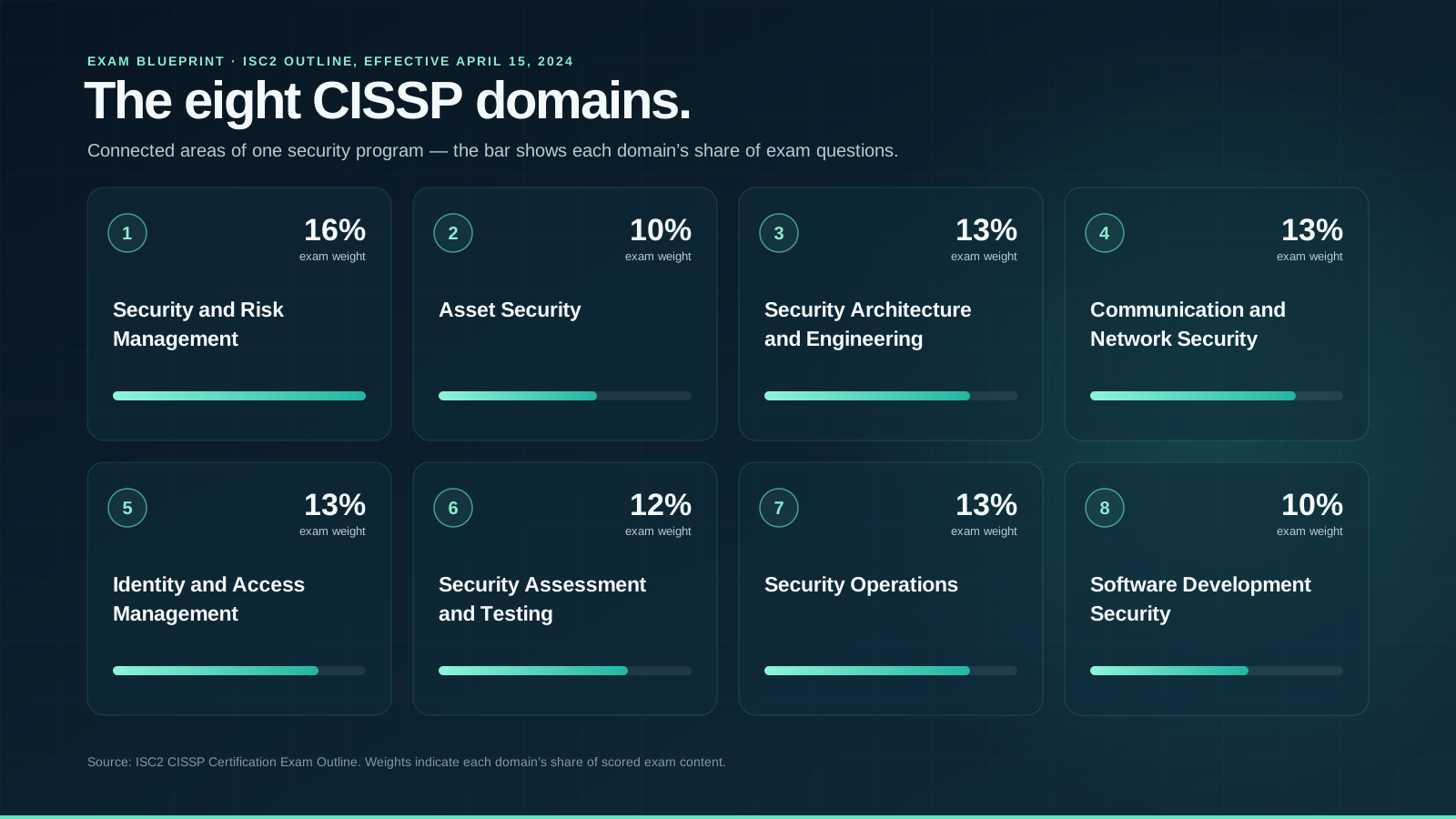
| Domain | Exam weight | The central question |
|---|---|---|
| 1. Security and Risk Management | 16% | Why are we protecting this, and who is accountable? |
| 2. Asset Security | 10% | What information and assets do we have, and how should we handle them? |
| 3. Security Architecture and Engineering | 13% | How do we build systems with appropriate protection? |
| 4. Communication and Network Security | 13% | How do we protect connections and information in transit? |
| 5. Identity and Access Management | 13% | Who or what should have access, and under which conditions? |
| 6. Security Assessment and Testing | 12% | How do we know our controls work? |
| 7. Security Operations | 13% | How do we keep services secure and respond when something goes wrong? |
| 8. Software Development Security | 10% | How do we build and acquire software securely? |
1. Security and Risk Management
This domain explains how security supports the organization. Topics include governance, professional ethics, risk assessment, policies, legal and regulatory obligations, personnel security, and business continuity requirements.
The practical skill is translating a security concern into a business decision. Finding a vulnerability is one thing; explaining its likely impact, available treatments, and accountable decision-maker is another.
Example: A business wants to launch a service before all identified weaknesses are fixed. The security team should explain the residual risk and available options. The appropriate authorized business owner makes the acceptance decision—not whichever engineer happens to be running the scan.
2. Asset Security
Asset Security focuses on information and assets throughout their lifecycle: identification, classification, ownership, handling, retention, and disposal.
Classification is more than attaching a label to a document. The label should influence who can access it, where it can be stored, how it can be shared, and when it should be deleted.
Example: A team wants to use production customer records in a test environment. The right questions include whether the data is necessary, whether a less sensitive substitute would work, and which controls and approvals are required.
3. Security Architecture and Engineering
This domain covers secure design principles, security models, cryptography, system capabilities, physical security, and architectural risks across different environments.
It helps to think in terms of properties and trade-offs. Encryption can protect confidentiality, but it does not automatically solve access management, key protection, or availability. A control can be technically strong and still be unsuitable for a particular requirement.
Example: A company encrypts backups but stores the only decryption key on the server those backups are meant to recover. The algorithm may be sound; the recovery architecture is not.
4. Communication and Network Security
This domain includes network architecture, protocols, segmentation, wireless networking, secure channels, remote access, and protection of network components.
Do not stop at memorizing protocol names. Understand what each mechanism protects, where trust boundaries sit, and what happens when a device or connection is compromised.
Example: A vendor needs access to maintain one application. Giving the vendor unrestricted access to the internal network is convenient, but a constrained connection with appropriate authentication, authorization, and monitoring better matches the requirement.
5. Identity and Access Management
IAM covers identification, authentication, authorization, accountability, federation, access-control models, and the provisioning lifecycle for people, devices, and services.
The distinctions matter. Authenticating a user establishes confidence in their identity. Authorization determines what that identity may do. Logging supports accountability, but only if events can be reliably associated with the relevant identity.
Example: An employee moves from payroll to marketing. Creating their new access without removing old permissions creates unnecessary privilege. Access management must cover transfers and departures, not just onboarding.
6. Security Assessment and Testing
This domain asks whether controls are effective and whether the evidence supports that conclusion. It includes assessment strategies, vulnerability assessments, penetration testing, audits, code review, reporting, and remediation follow-up.
A scan result is not the same thing as a complete assessment. Scope, authorization, test limitations, and the consequences of testing all matter.
Example: A backup dashboard reports successful jobs every night. A restore exercise discovers that a critical database cannot be recovered. The organization had evidence that backups ran, but insufficient evidence that recovery would work.
7. Security Operations
Security Operations covers the ongoing work of protecting services: logging, monitoring, investigations, incident management, patching, change management, resource protection, disaster recovery, and personnel safety.
Many topics become easier when you connect them to a process. During an incident, teams need defined responsibilities, trustworthy information, communication routes, and recovery priorities—not just a list of tools.
Example: A suspicious activity alert may require containment, but the response also has to consider evidence preservation and business impact. The appropriate action depends on the situation and the organization's approved procedures.
8. Software Development Security
This domain covers security throughout the software development lifecycle, including requirements, design, coding, testing, deployment, maintenance, and acquired software.
You do not need to be a full-time programmer to understand it. You do need to know why security belongs in the process before release and how different testing methods reveal different problems.
Example: A dependency scanner finds vulnerable libraries, but it will not necessarily identify a business-logic flaw that lets one customer view another customer's invoice. Several complementary assessment methods may be needed.
Why the connections between domains matter
A single business change can involve all eight domains. Introducing a new customer portal might require a risk assessment, data classification, secure architecture, network protections, access controls, security testing, operational monitoring, and secure development practices.
If you study each topic only in isolation, scenario questions become harder. Keep asking: Who is responsible? What requirement are we meeting? How will we know the control works?
How the CISSP exam works
ISC2 currently lists the following exam format:
| Exam detail | Current published information |
|---|---|
| Delivery | Computerized Adaptive Testing, or CAT |
| Time limit | 3 hours |
| Number of items | 100–150 |
| Question formats | Multiple-choice and advanced item types |
| Passing standard | 700 out of 1,000 points |
| Location | ISC2-authorized Pearson testing centers |
Confirm the latest exam outline and testing policies before scheduling, especially if you need a particular language or an accommodation.
What adaptive testing means for you
The exam adjusts its selection of questions using your previous responses and the exam's content requirements. It is not a fixed paper where everyone receives the same questions in the same order.
Once you finalize an answer, you cannot return to review or change it. That makes careful reading important, but it also means you need to make a decision and move on rather than spend several minutes chasing certainty.
ISC2 includes 25 unscored pretest items within the minimum-length exam. You cannot identify them, so treat every question seriously.
The number of questions is not a result prediction. An exam ending at 100 items can be a pass or a fail. Continuing beyond 100 does not automatically mean you are failing.
Does 700 out of 1,000 mean 70% correct?
No. Do not translate the published passing standard into a simple percentage of correct answers. Adaptive scoring considers item difficulty and estimated ability, so a practice-bank percentage is not a direct equivalent of the official passing standard.
Practice scores are useful for finding gaps and tracking progress. They are not an official forecast of your exam result.
Why experienced people still find it difficult
Most professionals are stronger in some domains than others. An engineer may be comfortable with network security but less familiar with governance. A risk specialist may understand policy well but need more work on cryptography or system architecture.
There is also a reading challenge. Several answers can sound reasonable, but the question may ask for the first action, the best control, or the primary responsibility. Those words change what you are being asked to decide.
Experience helps. It can also create a trap if you answer based on your employer's habits instead of the facts provided.
How to become CISSP-certified
Step 1: Check your eligibility
Map your work history to the domains and check whether you qualify for a one-year waiver. If you do not yet meet the experience requirement, decide whether the Associate route fits your career plans.
Doing this early avoids an unpleasant surprise after you have paid for training and passed the exam.
Step 2: Plan your preparation and budget
Download the current exam outline, choose a primary study resource, and assess your weaker areas. Set a schedule that works around your job and other commitments.
An employer may reimburse the exam, provide study leave, or pay for resources. Ask before purchasing; reimbursement policies sometimes require advance approval.
Step 3: Register and take the exam
Follow ISC2's registration process and choose an authorized testing center. Read the identification, appointment, accommodation, cancellation, and rescheduling requirements before exam day.
Make the travel arrangements boring. Knowing where to park and which identification to bring is more useful the night before than one last frantic chapter of revision.
Step 4: Complete the application and endorsement
After receiving official notification that you passed, follow ISC2's certification application process.
An ISC2-certified professional in good standing can endorse your experience. If you do not know an eligible endorser, you can request ISC2 endorsement, which requires proof of employment. Applications may be selected for audit, so retain accurate supporting records.
ISC2 currently requires the application process to be completed within nine months of the exam date. Candidates using the Associate pathway should follow the relevant Associate application instructions; the six-year experience window is not a reason to ignore the post-exam application process.
Step 5: Pay the applicable fee and receive certification
Once your application is approved, complete the applicable annual maintenance fee requirement. Wait for certification to be granted before presenting yourself as CISSP-certified.
Passing is a major milestone. It is not the final administrative step.
How much does CISSP certification cost?
The exam fee is the easiest cost to find, but it is not your whole budget.
ISC2 currently lists the standard CISSP exam registration fee as US$749 for the Americas and Asia Pacific, with regional pricing elsewhere. Taxes, currency, and the final amount depend on the testing location. Use the official pricing page and your registration checkout as the source of truth.
Costs to include in your plan
| Expense | What to account for |
|---|---|
| Exam registration | The applicable regional exam fee and taxes |
| Study materials | Current books, legitimate practice questions, or subscriptions |
| Training | Optional self-paced courses or instructor-led classes |
| Travel | Transport, parking, accommodation, or time away from work |
| Retake | A further exam fee unless covered by the terms of a purchased offer |
| Certification maintenance | The applicable annual maintenance fee and ongoing learning |
| Your time | Study evenings, weekends, and any leave you take |
For a simple USD planning example, US$749 for the exam, an assumed US$200 for study materials, and a US$135 first annual maintenance fee total US$1,084, before tax and travel. The US$200 is an illustrative budget assumption, not a quoted training price.
A bootcamp could make the total considerably higher. A second exam attempt would also change the budget. Expensive preparation is not automatically better preparation; buy something because it solves a specific learning problem, not because you feel anxious about the exam.
Do you need an expensive course?
No particular commercial course is required for certification.
Self-study may work well if you have relevant experience, can follow a schedule, and are comfortable resolving unfamiliar concepts independently. A structured course can help if you need explanations, accountability, or a clearer route through a broad syllabus.
Before buying, look for alignment with the current outline, sample teaching, transparent access terms, and useful explanations. Treat guaranteed-pass language carefully and read any refund or retake conditions.
CISSP salary: what can you realistically expect?
There is no single “CISSP salary.” Employers pay for a role, a level of responsibility, and the skills someone brings to it. The certification can support your candidacy, but it does not set your pay.
On its U.S. CISSP salary page, Payscale displayed an average base salary of approximately US$133,000 per year, with the page showing an update date of May 20, 2026, when checked for this guide.
That is a useful reference point, not a promise. It reflects reported salaries from people holding the credential across different roles and experience levels. It does not measure how much their pay increased because they earned CISSP.
The role matters more than the headline average
The same Payscale page listed these approximate U.S. role averages within its CISSP dataset:
| Role | Reported average annual salary, rounded |
|---|---|
| Cyber Security Analyst | US$104,000 |
| Cyber Security Engineer | US$123,000 |
| Information Security Manager | US$138,000 |
| Chief Information Security Officer | US$198,000 |
These are survey figures, not guaranteed offers or a career progression schedule. A CISO salary reflects executive responsibility; passing the exam does not make someone qualified for that role.
Location, industry, organization size, technical specialization, leadership experience, and the scope of the job can all change compensation. Base salary also excludes parts of a package such as bonuses or equity.
If you work outside the United States, do not convert the U.S. figure into local currency and treat it as your expected salary. Research comparable jobs in your own market.
How to use salary data sensibly
Start with your target role rather than the certification name:
- Find current vacancies at the seniority level you can realistically compete for.
- Check whether CISSP is required, preferred, or absent.
- Compare the responsibilities and other required skills with your experience.
- Review local salary ranges and separate base pay from total compensation.
- Ask whether certification would remove a hiring barrier or support a credible promotion case.
That gives you a more useful answer than a global average. CISSP may help you get considered; your experience and interview still need to explain why you are the right hire.
The career benefits of CISSP
1. It can help you meet a hiring requirement
Some employers use CISSP as a screening requirement or preference for experienced security roles. Having it can remove one obstacle to consideration.
It does not remove the others. Relevant experience, communication, technical judgment, and evidence of delivery still matter.
2. It broadens the way you approach security
The study process can be valuable even before you receive the credential. It forces you to connect your specialty to areas you may rarely work in.
A network engineer gains context for data ownership and business continuity. A compliance professional gains a clearer understanding of technical controls. Both can have better conversations with the teams they depend on.
3. It supports movement into wider responsibility
Senior roles often involve choosing priorities, reviewing designs, handling exceptions, and explaining trade-offs. CISSP provides a common foundation for those conversations.
The next step is to demonstrate that you can apply it. A certification is stronger alongside examples of decisions you influenced and outcomes you helped deliver.
4. It offers a recognizable signal across employers
Job titles vary. “Security consultant” can mean different things in different companies. A widely recognized credential gives employers another reference point when evaluating an unfamiliar background.
That is particularly useful when changing organizations or moving between technical and advisory work. It is still a signal, not a complete assessment of competence.
5. It encourages continued learning and professional connections
ISC2 membership, chapters, events, and continuing education can provide ways to stay engaged with the profession. Their value depends on participation, not simply paying a fee.
One important limit: an individual's CISSP certification does not make their employer compliant with a law or security standard. Organizational compliance depends on applicable requirements, implemented controls, evidence, and oversight.
When CISSP may not be the right next step
CISSP is not the best answer to every career problem.
You may get more value from a different path if:
- You are starting from scratch and need foundational IT and security knowledge.
- Your immediate goal is a hands-on specialty that employers assess through practical skills.
- You need expertise in a specific cloud platform or technology for your current role.
- You cannot yet connect much of the syllabus to real work and have no clear reason to take the Associate route.
- Your target employers rarely request the credential, while repeatedly asking for skills you do not yet have.
For comparison, Security+ is commonly considered for foundational security knowledge; CISM emphasizes security management; CISA focuses on audit and assurance; and CCSP focuses on cloud security. Each has its own requirements and purpose.
You do not need to collect all of them. Choose the next credential—or practical project—that closes the most important gap between your current role and your intended one.
How to prepare without wasting your study time
The biggest study mistake is not usually a lack of effort. It is spending that effort on familiar material because it feels productive.
Start with the outline, not a shopping list
Use the official outline as your checklist. For each topic, ask whether you could explain it, recognize it in a scenario, and distinguish it from related concepts.
Then take a diagnostic practice set. Review the explanations rather than focusing only on the score. A correct guess is still a gap.
Keep your resource list manageable: one primary learning resource, a legitimate question bank with good explanations, and a reference for topics that need deeper clarification. Switching between five courses can become a substitute for learning.
An adaptable twelve-week study plan
The following is a planning example, not an official schedule or a promise that everyone can prepare in three months. Adjust it to your starting knowledge and available time.
| Period | Focus | What you should be able to produce |
|---|---|---|
| Week 1 | Eligibility review, outline review, diagnostic questions | A realistic schedule and a list of weak topics |
| Weeks 2–3 | Security and Risk Management; Asset Security | Clear explanations of ownership, risk treatment, policy, and data handling |
| Weeks 4–5 | Security Architecture and Engineering | Explanations of design principles, security models, and cryptographic purposes |
| Weeks 6–7 | Communication and Network Security; IAM | Reasoned comparisons of network protections and access-control approaches |
| Weeks 8–9 | Security Assessment and Testing; Security Operations | Connections between assurance, incident handling, and recovery |
| Week 10 | Software Development Security; remaining gaps | An understanding of security across development and acquired software |
| Week 11 | Mixed scenario questions and timed practice | A short, specific list of recurring errors |
| Week 12 | Targeted review, pacing, and exam logistics | A calm final review and a clear exam-day plan |
Allow roughly eight to twelve focused hours a week if that is sustainable for you, but use understanding—not a completed calendar—as your readiness measure. If major gaps remain, adjust the schedule.
Make each study session do three jobs
For a particular topic:
- Learn it. Read or watch an explanation and connect it to a requirement or real situation.
- Retrieve it. Close the resource and explain the concept in your own words.
- Apply it. Answer fresh questions and examine why each option is appropriate or inappropriate.
Take access control as an example. Knowing what RBAC stands for is a start. Explaining why role-based access could suit one organization, why attributes might matter in another, and how access reviews address privilege accumulation is much more useful.
Keep an error log
For every meaningful mistake, write down:
- The concept you misunderstood.
- Why your chosen answer looked attractive.
- The detail that changed the correct decision.
- What you need to revisit.
You may discover that your problem is not “Domain 7.” It is confusing recovery objectives, overlooking a question's requested sequence, or choosing an operational action when the role calls for an authorization decision.
Specific weaknesses are easier to fix than vague ones.
Use practice exams as feedback, not reassurance
Practice exams help with breadth, pacing, and decision-making under pressure. They become less useful when you repeatedly answer questions you already remember.
Work with fresh questions where possible. Review low-confidence correct answers as well as incorrect ones. Look for consistent improvement across domains, rather than one impressive score on a familiar set.
A conventional mock exam also does not reproduce ISC2's adaptive scoring simply because it is labeled a “simulator.” Use it to practice relevant skills, not to predict the official stopping point or result.
Avoid exam dumps and purported real exam questions. They can violate exam rules, contain unreliable answers, and replace understanding with memorization.
Read scenario questions deliberately
Before comparing options, identify:
- Your role in the scenario.
- The objective being pursued.
- The constraints already stated.
- Whether the question asks for the first, best, primary, or most appropriate action.
Do not invent facts to make your favorite answer work. Do not use “always choose policy” as a shortcut. Choose the answer that best addresses the actual question.
Know when you are ready
No unofficial score threshold guarantees a pass. Better signs of readiness include being able to explain unfamiliar scenarios, distinguish closely related concepts, justify your answers, and manage time on fresh mixed-domain questions.
In the final days, focus on your error log, concise review notes, and logistics. Sleep is part of preparation. So is arriving without a last-minute identification problem.
Keeping your certification active
CISSP is maintained through continuing professional education and annual fees. It is not a one-time exam followed by a lifetime credential.
ISC2 currently requires:
- 120 CPE credits over a three-year certification cycle.
- At least 90 of those credits in Group A, covering activities related to the certification domains.
- The remaining 30 credits in Group A or eligible Group B professional development activities.
- An annual maintenance fee of US$135 for members holding CISSP, subject to ISC2's policies.
ISC2 recommends an annual pace of 40 CPE credits for CISSP. Spreading the work across the cycle is easier than trying to reconstruct three years of learning at the deadline.
Eligible activities can include relevant education, webinars, conferences, and professional contributions, depending on the activity and ISC2's rules. Keep supporting records and consult the current handbook rather than assuming every hour of ordinary work earns credit.
Associates of ISC2 have different maintenance requirements: currently 15 qualifying CPE credits annually and a US$50 annual maintenance fee.
Refer to the membership policies for the current requirements. Fees and policies can change.
Frequently asked questions
Can I pass CISSP in three months?
It is possible, particularly if you already have broad relevant experience and a consistent study schedule. Three months is less realistic if several domains are new to you or you have little time each week. Start with a diagnostic review and plan around the gaps you actually have.
Is CISSP difficult?
It can be. The challenge comes from the breadth of the syllabus, the need to interpret scenarios, and having to make decisions across areas outside your daily role. It is more manageable when you understand how the concepts connect rather than trying to memorize isolated facts.
Can I take CISSP without five years of experience?
Yes, you can take the exam without meeting the full certification experience requirement. Passing can lead to the Associate of ISC2 pathway. To become CISSP-certified, you must subsequently satisfy the qualifying experience and certification application requirements. An approved waiver can reduce the experience requirement by up to one year.
Do I need a degree?
No. A degree is not a universal requirement for CISSP certification. A qualifying degree may provide a one-year experience waiver, but you can qualify through the full experience requirement without one.
Does Security+ waive a year of experience?
CompTIA Security+ appears on ISC2's current approved credential list for the one-year waiver. Check the live list and application requirements when you apply. The total waiver remains one year even if you also have a qualifying degree or other approved credentials.
Does general IT experience count?
It may, if your responsibilities align with at least two CISSP domains and meet ISC2's experience rules. A job title or time spent in IT alone is insufficient. Document the security-related work you performed.
Do I need coding skills?
You do not need to be a professional programmer. You do need to understand secure development concepts, application risks, testing approaches, and how security fits into the software lifecycle.
What jobs can I pursue with CISSP?
Depending on your experience, relevant roles may include senior security analyst, security engineer, security architect, consultant, GRC specialist, or security manager. Executive positions require much more than certification, including leadership experience and a record of managing organizational risk.
Will CISSP guarantee a raise or a job?
No. It may satisfy a hiring requirement or strengthen a promotion case, but compensation and employment decisions depend on your market, employer, role, and demonstrated capabilities. Discuss any employer-funded certification or promotion arrangement before assuming a financial outcome.
What happens if I fail?
Use the domain feedback to identify gaps and change your preparation. ISC2 currently requires 30 test-free days after a first attempt, 60 after a second, and 90 after a third or subsequent attempt, with a maximum of four attempts per certification program in a twelve-month period. Verify the current retake policy before booking again.
Can I put CISSP after my name as soon as I pass?
No. Wait until ISC2 grants the certification. Exam success, Associate status, and full CISSP certification are different stages, and your professional profile should accurately reflect the stage you have reached.
Is CISSP worth it for you?
CISSP is most useful when it supports a clear next step: a senior role, broader security responsibilities, an employer requirement, or a deliberate effort to strengthen your understanding across the profession.
Before committing, answer four questions:
- Do the roles I want actually value CISSP?
- Do I meet the experience requirement, or have a sensible plan for the Associate pathway?
- Can I make time for learning across all eight domains—not just repeated practice tests?
- Am I prepared to maintain the credential afterward?
If the answers are yes, it can be a worthwhile investment. If not, a practical project, foundational certification, or targeted technical course may move you forward faster.
The credential can help tell your professional story. It cannot write that story for you. The strongest outcome is not simply adding five letters to your name; it is becoming better at explaining risk, evaluating controls, and making security decisions that fit the organization you are protecting.
Start with the official outline and an honest review of your experience. Choose a manageable study plan. Then use practice questions to find out what you still need to learn, rather than only confirming what you already know.
Sources and fact-checking notes
Requirements, exam details, and fees were checked against the following pages for this guide on October 8, 2026. Verify the live ISC2 information before registering or applying; this article is guidance, not an eligibility determination.
- ISC2: CISSP certification overview
- ISC2: CISSP experience requirements and approved credentials
- ISC2: CISSP certification exam outline
- ISC2: Computerized Adaptive Testing and exam FAQs
- ISC2: Exam pricing
- ISC2: Certification application and endorsement
- ISC2: Membership policies, certification maintenance, and designation rules
- Payscale: U.S. salary data for CISSP holders, page update shown as May 20, 2026.
The broad topics requested for this guide were informed by Destination Certification's CISSP overview. This article uses original wording, explanations, examples, and study guidance; current certification rules and pricing are drawn from ISC2 rather than the reference article.
CISSP is a registered trademark of ISC2. This is an independent educational guide and is not an official ISC2 publication.